

Scrolling through charming scenes of Black Cat Ranch in Elgin, Texas, I have to grant the marketing magic of social media. It’s no wonder it has thousands of Facebook likes. Once upon a time I might have been inspired to click the thumbs-up button myself.
But I know what those spectacles of pastoral communion are built upon, and that knowledge prevents me from feeling any warm sentiments.
Jennifer Crayton, director of Black Cat Ranch (also DBA Flying Pig Farm[s]), is the latest reinvention by a reportedly bipolar woman I encountered 20 years ago in my yard. She was Jennifer Oas then, she was Jennifer Terpstra when I met her again seven years later, and she has been Jennifer Allen, too, apparently.
Here’s Jen in a voicemail to me:
She afterwards clarified in conversation that the “crazy person” who had “threatened to call the police on [her]” blamed her for a woman’s suicide.
Jen has also called me a crazy, threatening person. Jen told me she was stalked from state to state by a crazy, threatening person. Jen’s last husband was caricatured as crazy and threatening. And I doubt strongly that the list ends there.

On the Facebook cover image of Jen Crayton’s current spouse, Elgin Fire Dept. Asst. Chief Eric Crayton, Jen’s face is cut in half like this, possibly to ensure that her present identity isn’t linked to her past ones by people who would recognize her. No images of Jen or Eric Crayton are returned by Google.
“Jen Crayton, humanitarian” is a reinvention, and so is Black Cat Ranch, a nonprofit that invites the public to send it money and that caters to children and other vulnerable clients, like first responders and veterans who may suffer from PTSD. When Jen moved to its location from Arizona, which is where the events recounted in this commentary occurred, the property belonged to a woman named Tiffany Bredfeldt, who I believe retains part ownership today.
The cautionary tale I have to tell of these two high-conflict women has dark elements. It could be upsetting to victims of trauma and isn’t suitable for small readers.
I was introduced to Jen Crayton in November of 2005 by a woman named Tiffany Bredfeldt who had come on to me alone in the dark at my home after installing a dressage horse in the boarding stable I live beside. Tiffany’s behaviors were advertising her body, contriving excuses to touch me (“Are you cold?”), and sexual taunting. One time she thrust her face in mine and wagged it back and forth like a bobblehead on a loose spring. The reader might suppose she was trying to tease a kiss, but it wasn’t that.
It was an attention-seeking game, one she played for months while my mom was being treated for cancer. Then she disappeared, probably worried I would find out she was married.
When I did, I made a considerate but vain effort to understand her, and then I demanded an explanation.

Jen Crayton, formerly Jen Terpstra, whose image is reproduced here for the purposes of identification, criticism, comment, reportage, and education in accordance with provisions of 17 U.S. Code § 107
In an email exchange over a weekend, Tiffany denied knowing what I was talking about, telling me that she had thought of me as a “friend” whom she had “never felt the need” to tell she was married. When this “apology” didn’t satisfy me, she made up a story for the police the next day. She said I had made an advance toward her, that she had “calmly explained her marital status,” and that I “acknowledged her wishes” and “did not push the issue further.”
A few months later to a superior court judge this became “several physical, romantic advances…that were subsequently rebuked [yet continued].” In three versions of the same story, I went from being a social friend to a sexual assailant.
I didn’t have a lawyer and didn’t know the first thing about representing myself to judges. The claims stood.
I found Jen a year later on MySpace using a Google search about topics the women had introduced into conversation when they had invited themselves into my house in 2005. I shared some of my creative writing there, too: I had wanted to publish humor for kids. I thought Jen might provide me with new information I could use to clear my record of her friend’s filth. The message Jen sent me put the kibosh on that.
I wasn’t able to write in earnest about my experiences with her friend until four years later…when I heard from Jen again.
I would call it “considering an affair.”
She apologetically responded to a blog I had started and now seemed eager to dish the dirt on Tiffany, whom she said she never saw anymore. I met Jen for coffee at her invitation, after which she insisted I give her a hug, and talked on the phone and emailed with her for months. She represented herself as my ally. I jokingly asked if she were misleading me, because she had first contacted me on April Fools’ Day.
Here’s that voicemail again (June 3, 2012), this time in its entirety:
She responds, “I’d never do something that cruel.”
She also asks about the welfare of my dog, who was my best friend and who needed a surgery. I became preoccupied with that and fell out of touch with Jen. Her emails had petered out after she reconnected with Tiffany, who sued me again the following year (2013).
Jen appeared as a witness for Tiffany and disavowed her emails and everything else she had told me. At the start of our correspondence in 2012, Jen had written: “I don’t lie or bend the truth” and “I have a deeply engrained distrust of the law and courts and avoid them at all cost” and “Even thinking about entering a courtroom sends me into an absolute panic.”
 Jen lied calmly under oath with her head high. It seemed to come naturally to her. She said she had invited me for coffee because she was “alarmed” and felt I was “confused.” She said I had asked “for facts about Tiffany’s sex life,” which she said was a “turning point” for her. She said she realized she “had made a gross error in judgment of [my] character.” Etc.
Her portrayals were effective; I was alone and caught off guard. The upshot was that the court unlawfully prohibited me from ever talking about the women again, and it would be another five years before I could get the court’s order dissolved with the help of an eminent constitutional scholar.
Protection from unfavorable disclosures getting out about her may have been what motivated Jen to contact me in the first place. Having me gagged was just a more certain way of achieving that end. It meant, besides, that Tiffany, a woman from a wealthy family, was in Jen’s debt.
The same year Jen appeared in court against me, domestic violence allegations were made against her (now ex-)husband. These escalated into his prosecution for assault with a deadly weapon. Consider the implications of the narrative the police recorded (click here to see a typographic rendering):
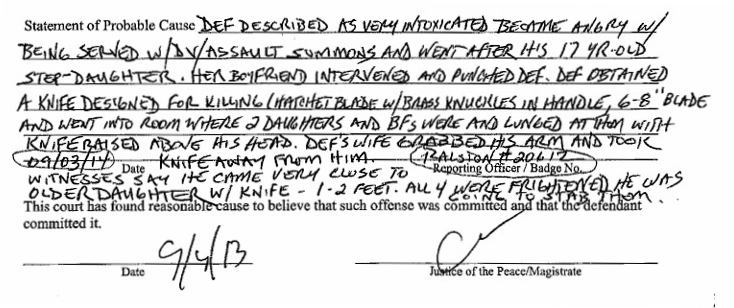
Today the most recent cover image on the man’s Facebook page has love hearts on it from Jen, from Jen’s daughter Mariah Allen, and even from Jen’s mom, a commercial artist who calls herself Joan Bemel Iron Moccasin. In a conversation I would have with a relative of the man’s in 2016, she would tearfully tell me that he was a sweetheart who had probably been provoked into making the display by teenaged daughters and a wife who she told me was diagnosed with bipolar disorder. The guy’s a self-professed pop-culture nerd whose Facebook page features pictures of him laughing with children and little dogs.
I continued to tell my story. Toward the end of 2015, someone who had monitored my habits waited until I ran past in the dark on the street where I live and drove a vehicle straight at me. It was meant to be a game of chicken, I guess; the driver veered away.
I was coincidentally sued again over the months to follow (2016) by both Jen and Tiffany, in Jen’s case repeatedly. Jen provided the melodrama; Tiffany paid the bills. Because they wanted to see me jailed (for protected speech to the world at large), I requested and was granted public defenders.
It took over two years, but all of the cases were dismissed. My First Amendment rights were restored in 2018, and since then I’ve broadened my insurance portfolio.
(For many months after I would begin writing again, somebody would creep near or onto the property where I live and rapidly fire off five or six handgun rounds in the dark and then slip away.)
Tiffany is now barred from reintroducing any of her copious claims against me in court, which are what Jen had piggybacked on. (Tiffany had besides filed police reports against me in at least two states and on all levels, including federal.) The only concession I had to make was not to apply these terms to her: “perjurer, felon, felonious conduct, criminal, fraud or fraudulent within her profession, narcissistic personality disorder, [or] adulteress.”

Tiffany Bredfeldt, today apparently divorced, maintains a Facebook page under the alias “Tiffanie Bretagne” on which she publishes digitally idealized images of herself, in one instance as royalty. This image is hearted by Tiffanie Bretagne. Jen Crayton’s mother-in-law posts flattering remarks there.
Jen had filed multiple reports in 2015 and 2016 with two different police precincts in Tucson where I live. In them she mocked the death of the dog whose health she had asked after a few years earlier by voicemail. I think Jen likes being regarded as a lover and protector of animals, but one of the first things she told me about herself was that she enjoyed catching butterflies and killing them in a jar.
Her allegations were completely off the wall, as the reader might guess. She told a policewoman (2015) that I had become “fixated” on her and began “stalking” her in 2005. Jen didn’t mention our correspondence in 2007 and 2012; it wouldn’t have supported her story. To a male detective (2016) she admitted we had met for coffee in 2012 but denied communicating with me afterwards, which contradicted her 2013 courtroom testimony and which both her 2012 emails and her voicemail’s time stamp expose as a lie. The detective was with a mental health task force. Jen had told him I was insane and said that she had bought a gun. After our interview, he handed me a number for a suicide prevention hotline. He ignored the emails.
Proceedings to evict Jen from her house were started the year she began reporting me to the police (2015). In one of the legal actions she initiated against me in 2016, which I quashed myself, she had her home address forwarded to me. She was living in an apartment.
 She left Arizona that year and evidently moved in with Tiffany on the 20-acre farm Jen had told me Tiffany’s father, a banker, had bought for her (currently estimated in value at $500,000–$750,000).
Today Jen calls that farm hers. She tends the homestead with her husband, Eric, a firefighter she married in 2021, and her daughter Mariah.
Mariah Allen’s father, whom I assume Jen was married to, apparently died in 2022 at the premature age of 60. On his tribute page, the only acknowlegment of his life’s worth is a condolence from the crematorium.
Copyright © 2025 EightLivesShy.com
TO THE READER: If you are or have been in a conflict with either of the women this story concerns, the writer would be interested to hear about it and will help if he can. He can be reached by leaving a comment—aliases are fine; email addresses will not be visible to the public—or by email using the contact form below. Confidences will be respected.
Send an Email
Thank you for your response. ✨

 Eight Lives Shy